
When you think of kitchen range hoods, what comes to mind? A statement design piece? A way to prevent your smoke alarm from going off? A noisy but necessary evil? Or, “I don’t think about it at all” (which is totally fair!)
As designers, we think about range hoods a lot: what they look like, yes (we always want a cohesive design aesthetic), but more importantly, how they function.
While the MN Building Code does not require a range hood in kitchens, we believe they’re a non-negotiable. Why? Because the act of cooking creates multiple impacts on your home:
| Cooking Byproduct | Impacts on Your Home & Family |
| Smoke | Lingering odor, potential fire alarm impact |
| Grease | Coats your cabinets, counters, windows, or nearby fabrics (i.e. shades or cushions) |
| Moisture | Rising steam increases humidity and can lead to mold growth |
| Airborne Pollutants* | Potential respiratory irritation or illness |
*Airborne pollutants including methane and nitrogen oxide are released with gas cooking; PM2.5 particulates are released from both gas and electric cooking. Depending on your cooking methods and local gas supply, pollutants such as benzene, toluene, ethylbenzene, xylenes, and other VOCs may also be released.
The vents in range hoods capture all of these: odors and grease molecules; moisture from rising steam; methane, fine particulates, and VOCs. In doing so, vent hoods protect your home’s finishes and your indoor air quality.
But beware! Range hoods only work when you turn them on. Turn it on when you START cooking, not once you’re in danger of setting off the smoke detector. (We’re all guilty of this one.)
Join us down the rabbit hole as we look into all the factors we consider when choosing kitchen venting systems, along with the products we reach for again and again.
Fair warning: this will be quite the deep-dive! Here’s the TL;DR if you need to come back later:
- Vent hoods help protect your kitchen from grease, steam, and lingering odors
- Turn them on when you start cooking, not once smoke appears
- Larger hoods often require “make-up air” systems in Minnesota homes
- Exterior-vented hoods are more effective than recirculating options
- A larger capture area helps contain rising steam before it impacts nearby finishes
- Easy-to-clean filters make regular maintenance much more manageable
Range Hood Types
Under-Cabinet
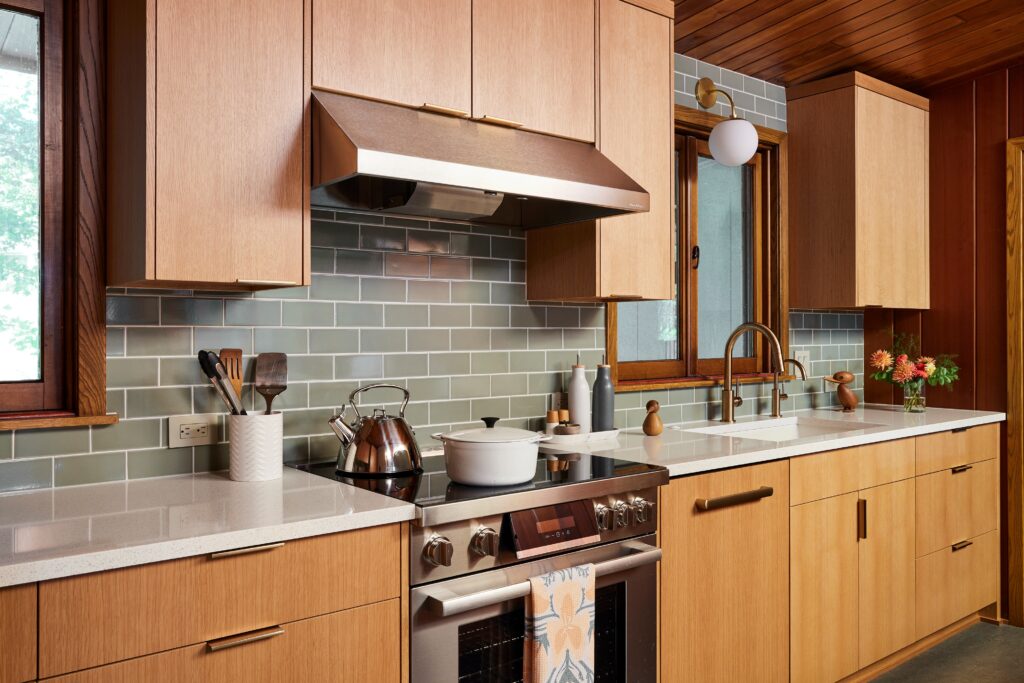
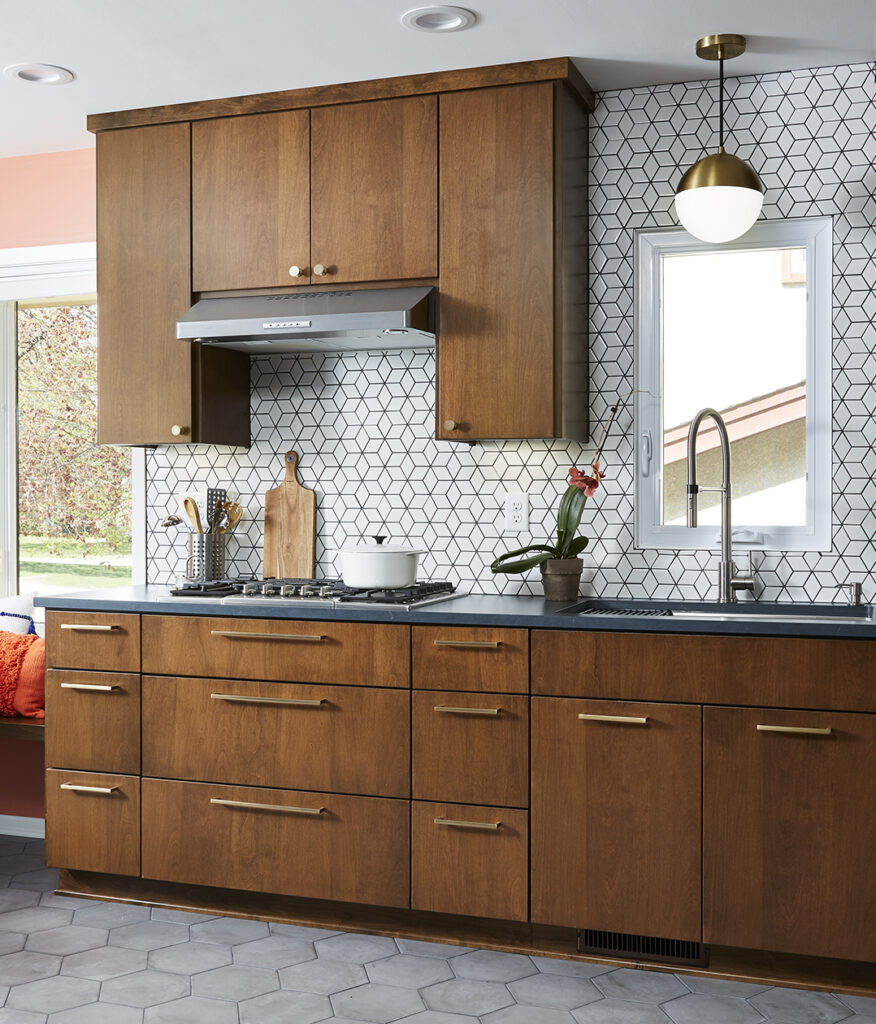
As the most common type of range hood, you’ve likely encountered an under-cabinet range hood in your life. They mount directly to the underside of the upper cabinet directly above the cooktop. The cabinet provides the structural support, and the hood sits flush against it, keeping the overall profile low and compact. The ducting runs up and out of the house through the cabinet above.
Fox Interiors Project: MCM Meets 2020
Pros:
- Installs easily in most existing kitchens without significant modification
- Available in sizes from 24″ to 36″ to suit standard range widths
- The most affordable option across all ventilation types
- Most effective for removing steam, heat, and odors from the home
- Unobtrusive profile that integrates with existing cabinetry
- Allows for concealment of a duct path that needs to run vertically out of the hood and then horizontally through adjacent cabinets before exiting the home
Cons:
- Requires a cabinet above the cooktop for mounting
- CFM* range is more limited than wall-mounted range hoods
*CFM stands for Cubic Feet per Minute, and is the unit of measurement used to calculate range hood efficacy (and a different rabbit hole entirely!) All you need to know is that there are recommended ranges for optimized ventilation, and that as your design team, we know them all and will make the right recommendation appropriate to your home’s needs.
Wall-Mounted (Chimney)
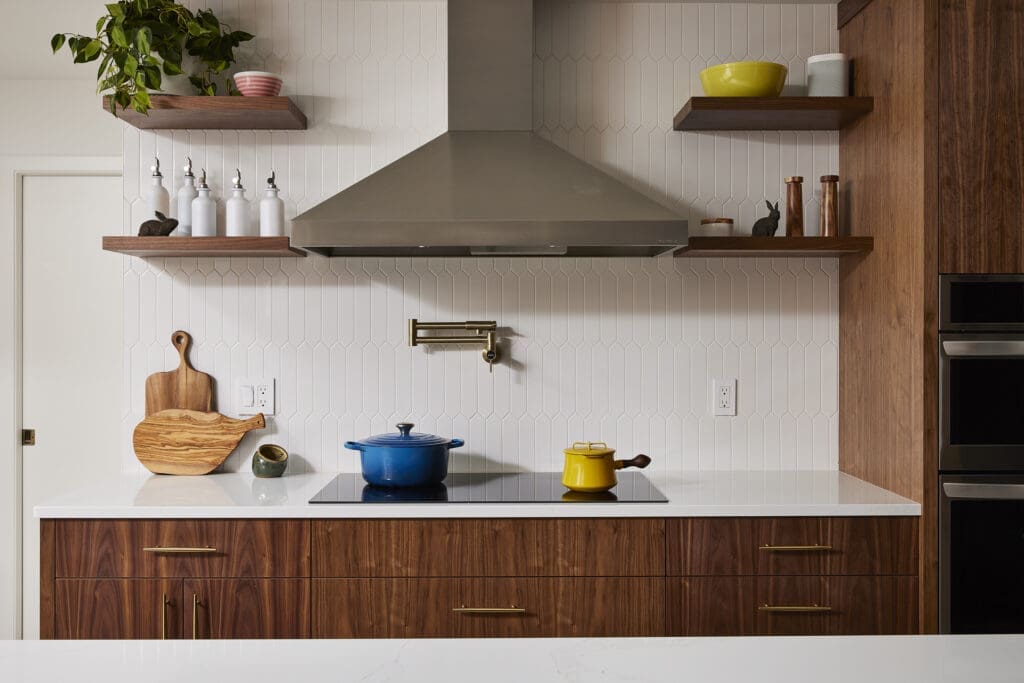
Wall-mounted range hoods attach directly to the wall above the cooktop and extend upward toward the ceiling through a chimney-style duct cover. The hood is anchored to the wall, and the chimney section conceals the ductwork running to the exterior.
Fox Interiors Project: Midcentury Magic with stainless steel wall-mounted range hood
Pros:
- Most effective for removing steam, heat, and odors from the home
- Does not require an upper cabinet, allowing for a more streamlined look or the addition of open shelving
- Comes in the best range of design styles and options
- Available as a standalone exposed hood or a liner inside a custom hood
- Wide range of CFM options available to accommodate standard ranges to commercial-style ranges 36” wide and above with high BTU burners
Cons:
- Requires a vertical wall-side duct path to the exterior or a ductless conversion kit
- Takes up wall space that might otherwise be used for storage or design
- Typically costs more than comparable under-cabinet models
Island Range Hood
Island range hoods are ceiling-mounted and designed specifically for kitchen island cooktops. Because there is no wall for structural support or ductwork routing, the hood is suspended from the ceiling and vented either through a hidden duct run within the ceiling or a decorative chimney column.
Image via Vent-a-Hood

Pros:
- Makes island cooktop plans possible
- Makes a strong visual statement in open-plan kitchens
- Available in a wide size range, up to and including professional-size island ranges
- Available as a standalone exposed hood or a liner inside a custom hood
Cons:
- More complex and costly to install than wall-mount or under-cabinet options
- Requires confirmed duct access through the ceiling structure
- Higher CFM models are needed to compensate for the open airflow on all sides
Downdraft
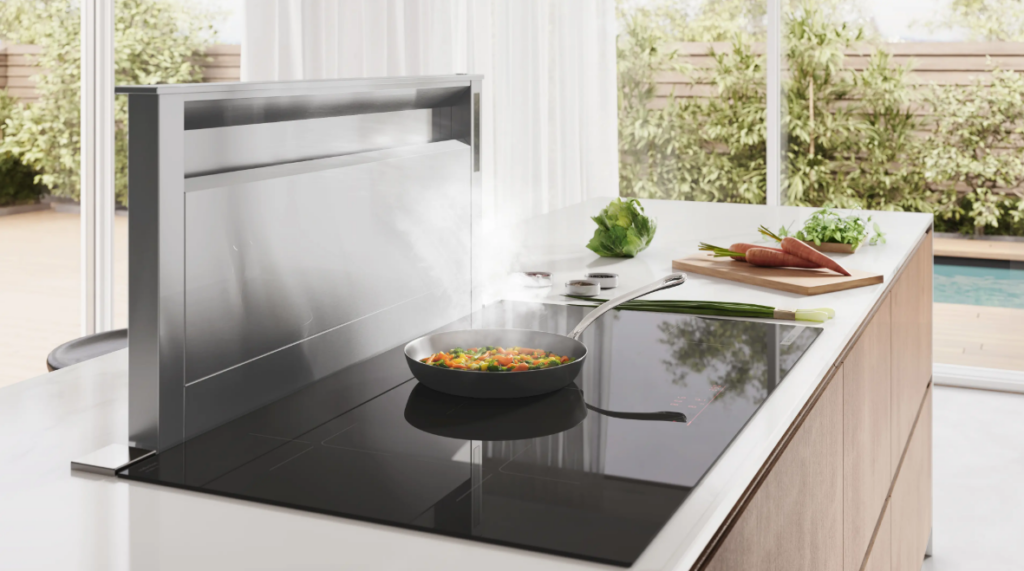
These vents are built into or mounted behind the cooktop, rather than above it. Instead of capturing rising smoke and steam from overhead, a downdraft system pulls air downward and exhausts it through ductwork running beneath the floor or behind the range wall. For this reason, these are typically utilized for island and peninsula applications, or in other circumstances where overhead venting is not possible.
Image via Bosch
Pros:
- Slim, concealed design that is recessed into the space behind a cooktop allows for clear sightlines
- No overhead structure, ceiling support, or wall mounting required
- Available as integrated cooktop-downdraft combination units
Cons:
- They do take up a fair amount of space in the cabinetry below, so you lose cabinet space below the cooktop to accommodate the system
- Not very effective for high-intensity cooking like heavy searing and wok cooking that produces dense smoke and grease
- Not recommended for gas ranges, especially ones with high total BTUs
- Not a lot of options available below 600CFM
Recirculating
For condos, apartment buildings, and homes without an easy path to run the required ductwork outside, recirculating vent hoods can be the best (or only) option to provide the benefit of ventilation.
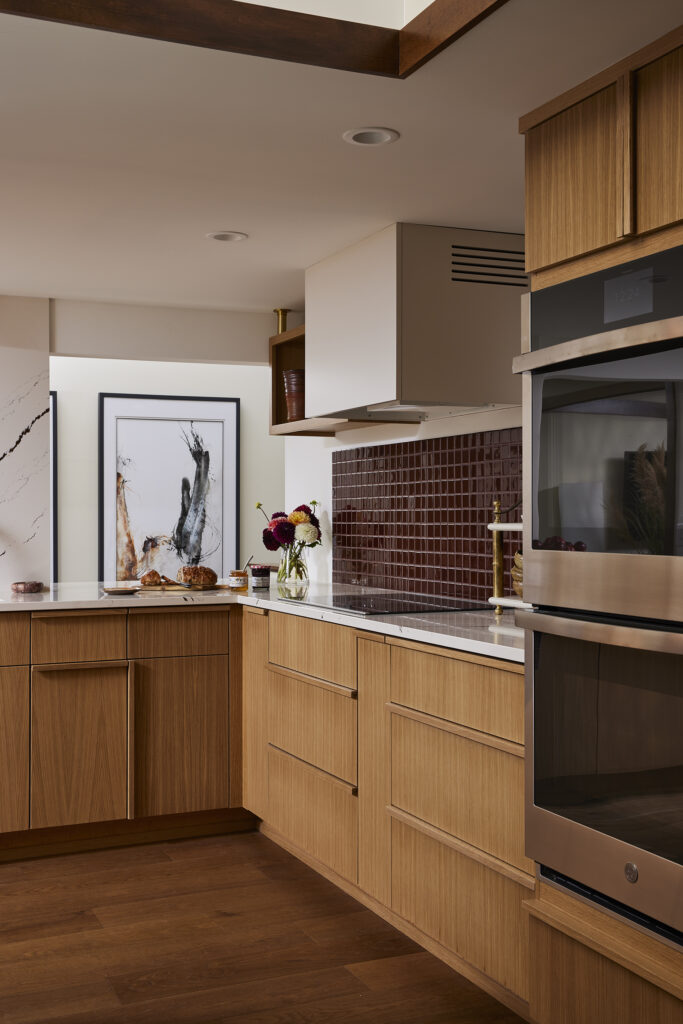
Fox Interiors Project: North Oaks Organic Modern with recirculating Vent-A-Hood liner with a four-step filter system
Building Limitations:
For standard vent hood ducting, there are specific requirements about the minimum spacing between the duct’s exit point and nearby operable windows and doors that can limit installation options. Additionally, if floor joists above the kitchen run perpendicular to the ideal direction for the ducts to run, the duct will likely need to be installed below the ceiling as it runs across the room. With custom cabinetry, this can be concealed at the back of the top of the upper cabinets.
In some homes, though, this just isn’t possible, which is when recirculating vents become the best, or only, option.
Pros:
- Can be installed anywhere: no venting to the exterior required
- Typically a slim design
- No loss of cabinet space since there is no ductwork running up and out of the top of the hood
- Available as a standalone exposed hood or a liner inside a custom hood
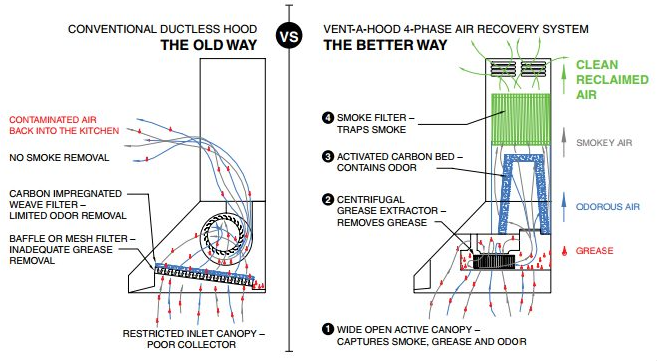
- Vent-A-Hood makes the only recirculating vent hood with a multi-step filtration system that includes a capture area for the steam
Cons:
- Most models aren’t able to remove the heat and grease from the home
- Steam rises faster than its fan can capture it. This limits its effectiveness at preventing grease-filled steam from coating your cabinetry.
- Cooking smells recirculate in the home
- Filters are generally difficult to clean, meaning people rarely wash them or replace them, reducing their effectiveness
- Some models require the air to circulate back out of the top right side of the hood, which can limit placement options if your design calls for cabinets on both sides of the hood.
Fox Interiors’ Pick:
Vent-A-Hood has a recirculating hood that includes a 4-step filtration system for improved odor control and grease capture, which is our pick for recirculating range hoods. The diagram below details the benefits of this system over traditional ductless ventilation systems.
Filter Types
Just like changing your car’s oil filter or your home’s AC filter, all range hoods have filters that require regular maintenance. A clogged filter reduces airflow, lets grease reach the blower, and makes the entire ventilation system less effective, regardless of how powerful the hood is.
Additionally, range hood filters are not interchangeable: each type is designed for a specific ventilation method, cooking load, and maintenance routine. Using the right filter for the hood and cooking setup makes a measurable difference in how well your hood performs and how long it lasts.
Here are the primary types of vent filters.
Baffle
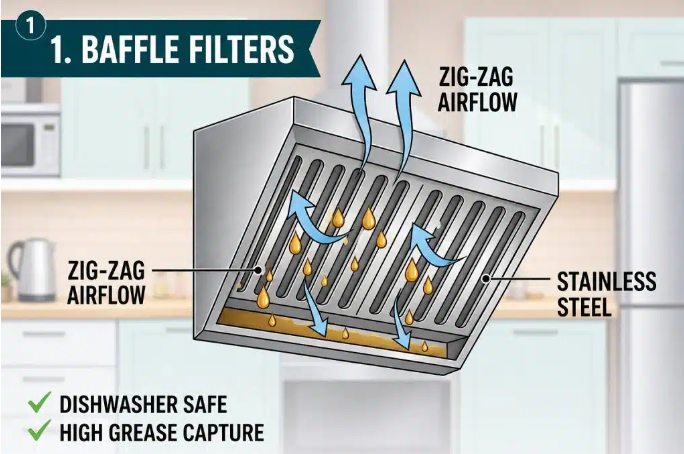
Built from interlocking, alternating metal V-shaped panels (usually stainless steel). As greasy air is forced to make rapid, sharp turns through the baffles, the heavy grease condenses and clings to the metal, dripping down into a collection channel. They are highly durable, dishwasher-safe, commercial-grade, and do not lose performance as they fill up. However, due to their configuration, they can be difficult to clean by hand as all those edges can be sharp.
Diagram via Vent Hood Insider
Mesh Filters
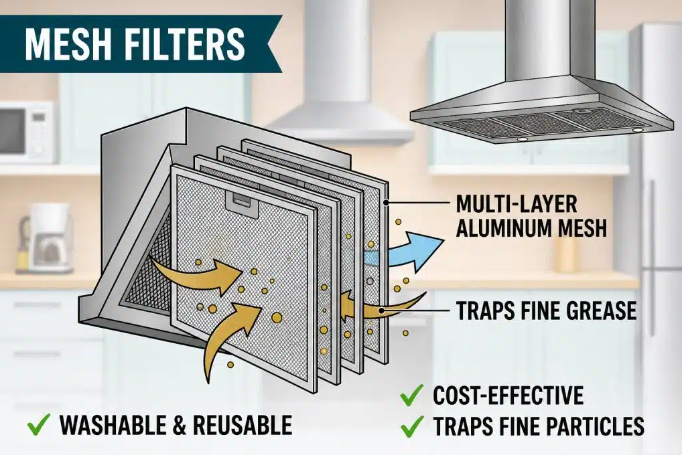
Constructed from multiple layered, woven aluminum or stainless steel wire grids. Grease sticks to the mesh as the air passes directly through it. They are highly effective for lightweight everyday cooking, but they clog quickly and require frequent cleaning to avoid restricting airflow. If you wait too long to clean them, which is a messy process, they lose their effectiveness.
Diagram via Vent Hood Insider
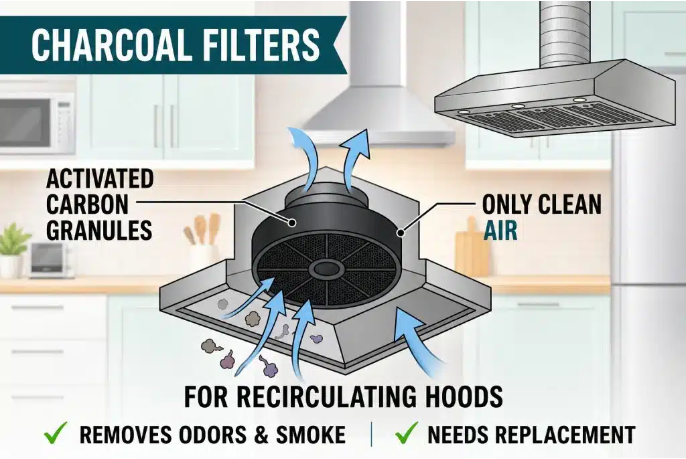
Charcoal Filters
Used in recirculating (ductless) vents. Air passes through activated carbon to chemically absorb cooking odors, gases, and VOCs. They cannot be washed and must be replaced every 3-6 months. They are always paired with a mesh or baffle pre-filter to catch the grease first.
Diagram via Vent Hood Insider
Magic Lung Blower
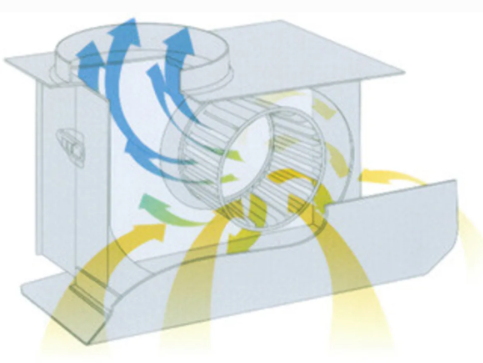
Exclusive to the brand Vent-A-Hood, the Magic Lung Blower uses a wide-open “active canopy” that pulls vapors into a specialized blower compartment, instead of forcing smoke and grease through a restrictive mesh screen or metal baffle. Once inside, a high-speed, spinning blower wheel uses centrifugal force to liquefy and separate 99% of the grease from the airstream. Without a traditional filter blocking the path, air flows more freely, making them quieter than conventional hoods and preventing grease from traveling into the ductwork. The blower compartment is easy to remove and wipe down by hand or run through the dishwasher. This is our preferred style.
Diagram via Vent-a-Hood
Congrats! You made it to the end of the post. We obviously love to geek out over all the details of ventilation! Save this for when you’re ready to start thinking about your kitchen remodel.
And if this was pure information overload, don’t worry: you don’t need to know and understand all (or any) of this. That’s our job. We’re happy to provide you with just enough information to make an informed decision for your life and your home.
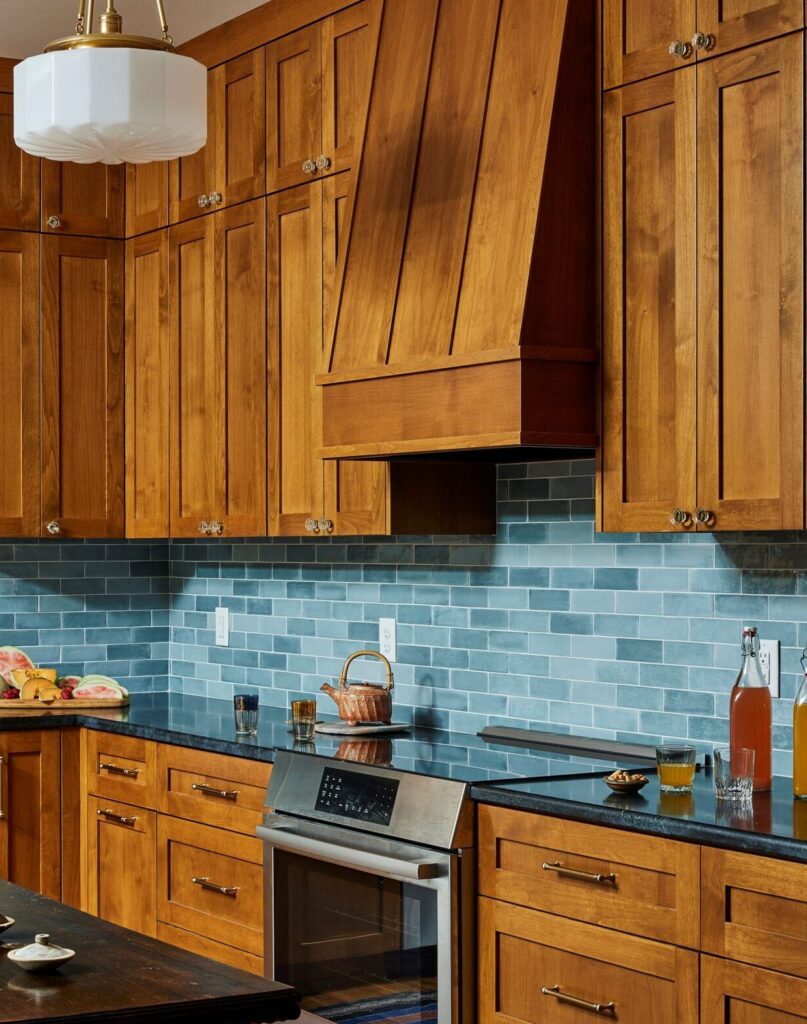
Due to ceiling restrictions, the ducting was concealed behind the crown at the top of the cabinets.

